
It’s the 26th. Tihar shoppers are crowding your counter, the cash drawer is full, and then it hits you: the VAT return was due yesterday. Now you’re wondering what the VAT penalty for late filing in Nepal will cost, and whether it’s worth losing sleep over.
Take a breath. The fine is real, but it’s usually smaller than people fear if you act fast. However, it grows every day, so waiting is the expensive choice.
In this guide, you’ll see exactly how the Inland Revenue Department (IRD) charges late fees and interest, what a delay costs in rupees, and how to cut the bill. There’s also good news for older defaulters: a time-limited amnesty is open right now.
Key takeaways
✔  VAT returns are due by the 25th of the following Nepali month.
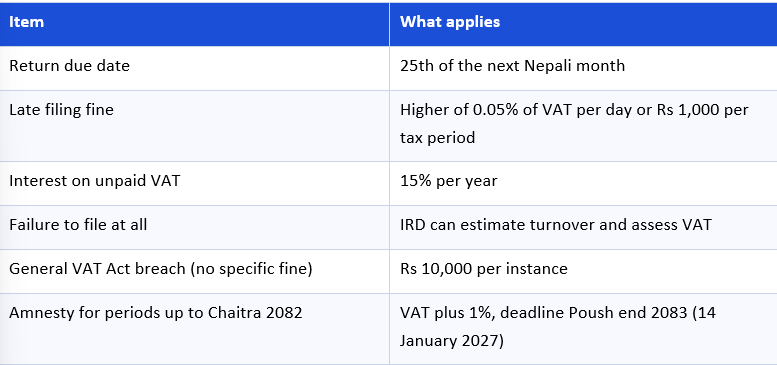
✔  Filing late costs the higher of 0.05% of the VAT per day or Rs 1,000 per tax period.
✔  Unpaid VAT also attracts 15% annual interest, and the two charges stack.
✔  An amnesty lets eligible businesses clear old VAT by paying the tax plus 1% before Poush end 2083 (14 January 2027).
How the VAT Penalty for Late Filing Works in Nepal
Nepal charges VAT at 13% under the Value Added Tax Act, 2052. Most registered businesses file a return every month and deposit the tax by the 25th of the next Nepali month. So Kartik sales are due by Mangsir 25.
Miss that date and two separate charges begin. One is a fine for filing late. The other is interest on any VAT you haven’t paid. Many owners mix them up, so let’s take them one at a time.
The Fine for Filing Late
According to IRD procedure summaries, the fine for failing to submit a return is the higher of two amounts: 0.05% of the VAT per day, or Rs 1,000 per tax period.
The “whichever is higher” part matters. If you owe a lot of VAT, the daily percentage wins. If you owe little or nothing, the Rs 1,000 floor applies. That’s why even a nil return filed late can cost you. In fact, many small shops pay only the Rs 1,000 floor.
Interest on Unpaid VAT
Interest is a different charge. Also, any VAT you deposit late carries 15% interest per year, counted for the days you’re behind.
In other words, the fine punishes the missing paperwork, while interest punishes the missing money. File late and pay late, and you’ll face both.
Other Charges That Can Stack Up
If you never file at all, IRD can estimate your turnover and assess VAT for you. That estimate comes with its own penalties and interest, and it’s rarely in your favour.
The Finance Act 2083 also raised the general penalty for breaching the VAT Act or its rules, where no specific fine applies, from Rs 1,000 to Rs 10,000 per instance. Careless record keeping can therefore cost you more than before.
What a VAT Penalty for Late Filing Really Costs: A Worked Example
Numbers make this easier to feel. For example, suppose your return shows Rs 2,00,000 of VAT payable, and you file and pay on the same day.
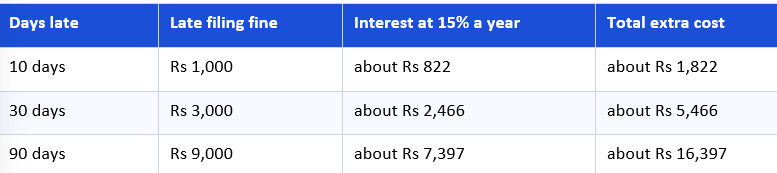
This is an illustration, not an IRD assessment. Still, the pattern is clear. Ten days of delay is an annoyance, but three months is a real hit to your margin.
Notice also that the fine alone doubles from 30 to 90 days in this example, while the tax itself never changed. You’re paying purely for time.
The Poush 2083 Amnesty: Your Best Way to Cut the Bill
Here’s the part many owners miss. The Finance Act 2083 opened a settlement window for VAT defaulters, and it closes at the end of Poush 2083, which is 14 January 2027.
Under this scheme, because it targets defaulters, a VAT-registered person who missed collecting, depositing or filing VAT can regularise the position. You file the outstanding returns, pay the VAT, and add 1% on top. In return, the interest, additional fees and penalties are waived.
Using our earlier example, the Rs 2,00,000 VAT bill would carry an extra Rs 2,000, not Rs 16,397.
A separate route covers people who filed returns but never paid the declared tax. Likewise, they can settle by paying the unpaid amount plus 1%.
However, read the fine print before you celebrate:
- The VAT amnesty is tied to returns up to Chaitra 2082 (mid-April 2026). Later months are not covered.
- You must complete the filing and payment before the deadline. The government has not hinted at an extension.
- Rules can differ by category, so confirm your case with IRD or your accountant.
With roughly ten weeks left, this is the time to act, not to think it over.
Steps to Limit the VAT Penalty for Late Filing
Already late? Work through these steps in order.
1. File now, even if the numbers are rough. The daily fine keeps running until the return is in. An accurate return filed today beats a perfect one filed next month.
2. Pay the VAT with the return. Interest keeps counting on unpaid tax, so deposit it the same day if cash allows.
3. List every missing period. Check the IRD taxpayer portal for each month you skipped. Don’t assume only one is outstanding.
4. Check the amnesty first for older periods. If the months fall on or before Chaitra 2082, compare the full penalty bill with VAT plus 1%.
5. Collect your bills and invoices. Sales invoices, purchase bills and bank slips support your input credit. Without them, you may lose VAT you were entitled to claim.
6. Ask your accountant to review before you submit. A fast filing with a wrong figure creates a second problem.
7. Set a reminder for the 20th. Five days of buffer saves you from most last-minute panic.
Mistakes That Make Late Returns Worse
Some habits turn a small delay into a big bill. So, to keep the VAT penalty for late filing as low as possible, watch out for these.
Skipping the nil return. No sales this month? You still have to file. A nil return filed late still carries the Rs 1,000 floor.
Filing without paying. A submitted return with unpaid tax stops the filing fine, but interest keeps running. So pay, or use the settlement route if you’re eligible.
Ignoring IRD notices. Letters and portal messages come with response windows. Also, missing them can lead to assessment and bigger charges.
Assuming the amnesty covers everything. It doesn’t. A return you miss next month isn’t forgiven by a scheme aimed at older periods.
Why Returns Run Late, and How to Stop It
Most late returns aren’t about bad intent. Instead, they come from messy records, and messy records are behind most cases of the VAT penalty for late filing. A bill sits in a drawer, a purchase isn’t entered, and then the accountant waits for figures that never arrive.
Festival months make it worse. Dashain and Tihar bring heavy sales, long shop hours and holidays. As a result, the 25th arrives before anyone notices.
The fix is simple, even if it isn’t glamorous. First, record every sale and purchase on the day it happens, and keep one clean VAT summary ready before the deadline. A business system such as Udyot ERP, built for Nepali companies, can keep invoices, purchases and VAT figures in one place, so month-end isn’t a scramble.
Udyot tip: when billing and purchase entries live in one system, your VAT figures are ready sooner. See how it fits IRD requirements.Quick Summary: VAT Penalty for Late Filing at a Glance
FAQ
Do I have to file if I had no sales this month?
Yes. File a nil return on time. If you file it late, the Rs 1,000 minimum can still apply.
Does the fine stop once I file?
The late filing fine stops growing when the return is submitted. Interest, however, continues until the VAT itself is paid.
Can I use the amnesty for a return I’m late on this month?
No. The VAT amnesty targets returns up to Chaitra 2082. File and pay current months as quickly as you can to keep the cost down.
Where do I check what I still owe?
Log in to the IRD taxpayer portal to see your filing status. For rules and circulars, visit the Inland Revenue Department website.
Final Thoughts
A late VAT return is a bad day, not a disaster. Ten days costs little. Ninety days hurts. And if your missed months fall within the amnesty, you can wipe out most of the penalty by paying the tax plus 1%.
So here’s your next step. Open the portal today, list every unfiled month, and decide which ones qualify for the Poush 2083 window. Then set a reminder for the 20th of each month so the VAT penalty for late filing never catches you again.