
It’s 7 pm in a busy pharmacy. A customer wants a strip of antibiotics, another is waiting on a credit bill, and your assistant is hunting for a box at the back shelf. Sound familiar? The right pharmacy software in Nepal turns that rush into a calm, searchable record.
But “best” depends on your shop. A single counter in Itahari has different needs from a wholesaler in Birgunj or a five-branch chain. We built Udyot ERP, so we’ve put it first. Still, this guide compares seven options fairly, shows what each one suits, and ends with a checklist you can use with any vendor.
Key takeaways
✔  The best pharmacy software in Nepal does three jobs well: IRD-compliant billing, stock control, and clean records for your accountant and the DDA.
✔  Pharmacy-only tools suit a single counter. An all-in-one ERP like Udyot suits shops that also need accounting, payroll and VAT in one place.
✔  Always ask for IRD approval proof and test any software with your own medicine list.
✔  Run a one-week trial before you pay. Support quality matters as much as features.
Why Pharmacy Software in Nepal Needs More Than Billing
A grocery shop can get by with a billing app. A pharmacy can’t, because medicines come in batches, they expire, and the rules are stricter.
According to the Department of Drug Administration (DDA), pharmacies have ongoing duties such as proper record keeping, expiry management and pharmacist supervision. Meanwhile, the DDA has ordered recalls of substandard paracetamol batches in recent months and told shops not to sell them. If you can’t search your stock quickly, you can’t act on a recall quickly.
Then there’s tax. Billing software used in Nepal must be certified by the Inland Revenue Department (IRD), and the shop also needs its tax office’s approval to use it. Large taxpayers must also connect to the IRD’s Central Billing Monitoring System (CBMS). That’s why the billing side of pharmacy software in Nepal matters so much.
What to Look for in Pharmacy Software in Nepal
So before you compare names, decide which features you can’t live without. Here’s a practical short list.
- IRD-verified billing. Ask for the certificate or find the software on the IRD’s approved list. For larger shops, check CBMS support.
- Stock control. Real-time stock, reorder alerts and physical stock counts, so the shelf and the system agree.
- Batch and expiry tracking. Ask exactly how the software records batch numbers and expiry dates, and how it warns you.
- Fast counter billing. Barcode scanning, quick item search and a clean printed bill.
- Bikram Sambat dates. Your registers and fiscal year follow the BS calendar, so the software should too.
- Credit (udharo) ledger. Many clinics and regulars pay later, so you need dues tracked per party.
- Staff access control. The counter assistant shouldn’t see the same screens as the owner.
- Local support. A Nepali-speaking team that answers the phone matters more than a long feature list.
Udyot tip: Udyot has role-based access (admin, accountant, staff, viewer) and an audit trail that logs every change with the user and time, so you always know who edited a bill.Pharmacy Software in Nepal at a Glance
Here’s a quick view of the options we found. Details come from each vendor’s own pages, so treat them as claims to verify in a demo.
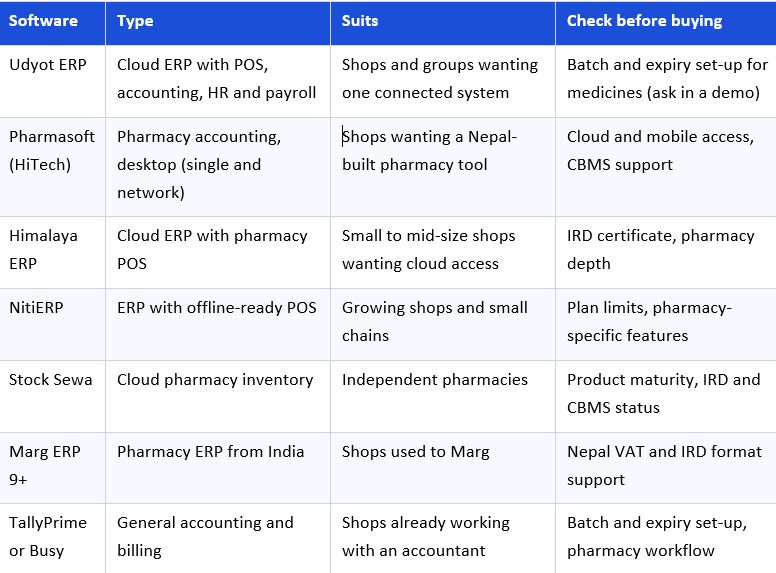
The Seven Options, One by One
Udyot ERP
Udyot is a cloud ERP built for Nepali businesses. It puts accounting, inventory, POS, HR, payroll, CRM and VAT in one system, so a sale updates your stock and your books together. It’s IRD-verified and uses Bikram Sambat dates throughout.
For a pharmacy, the counter side is covered. For example, the POS scans barcodes with a USB scanner or a camera and prints thermal receipts. Meanwhile, inventory handles multiple godowns, FIFO or weighted-average valuation, low-stock alerts and physical counts. You can see the details on the features page.
It suits shops that want billing, stock, VAT returns and staff salaries in one place. Also, since every pharmacy runs medicines differently, ask for a demo with your own items and check how batch and expiry dates are set up.
Pharmasoft by HiTech
HiTech Solutions & Services is a Kathmandu company founded in 1998. According to its listing, Pharmasoft was built for the Nepalese pharmaceutical accounting environment and comes in single-user and network versions.
It suits shops that want a locally built tool from a long-standing vendor. However, ask about cloud access and about CBMS if your turnover is large.
Himalaya ERP
Himalaya ERP is a cloud platform for accounting, billing, inventory, POS and more. Its pharmacy POS supports barcode scanning and drug interaction alerts, and the vendor says it syncs with CBMS. Also, because it runs on the cloud, you can check sales from your phone.
It’s a good fit when you want one system for the shop and the books. Still, confirm the IRD certificate and see how it handles returns.
NitiERP
NitiERP says it is IRD-approved and connected to CBMS, with offline-ready billing that syncs when the internet returns. Its listing shows a Business plan at about $29 per month, though prices change, so confirm the current rate.
It works well for growing shops that also need accounting, payroll or multiple branches. However, since it covers many industries, test the pharmacy side with your own stock.
Stock Sewa
Stock Sewa is a newer cloud inventory ERP aimed at pharmacies in Nepal. It covers billing, expiry dates, purchases, sales and suppliers. The team launched it on Product Hunt and said it is still improving the product.
That makes it interesting for independent shops that want something simple. On the other hand, newer tools deserve extra questions about IRD approval, support hours and data backup.
Marg ERP 9+
Marg is a well-known pharmacy ERP from India, and it appears on Nepal software lists. In fact, many pharmacists already know it. Still, the catch is local fit. Ask whether it produces Nepal VAT bills, BS dates and the sales and purchase books in the IRD format.
TallyPrime or Busy
These are general accounting tools, not pharmacy tools. Even so, many Nepali businesses already use them. Busy’s Nepal partner says it is approved by the IRD for e-billing on the cloud.
They make sense if your accountant already works in them. In that case, check how batch and expiry tracking is set up, because it won’t be as smooth as in a pharmacy-first product.
Why Udyot ERP Is Better Pharmacy Software in Nepal for Growing Shops
A pharmacy-only tool handles the counter well. The trouble starts when the shop grows, because suddenly you need VAT returns, staff payroll, a second branch and an accountant who wants clean reports. That’s where Udyot pulls ahead.
- One system, no double entry. Because billing, stock, accounting, HR and tax share the same data, you stop retyping numbers between apps.
- IRD-verified reporting. Udyot produces VAT returns, Annex 1 to 9 and TDS returns in IRD formats, with Excel export for upload to the taxpayer portal.
- Payroll built in. PF, SSF and TDS calculate automatically, so paying your pharmacists and counter staff doesn’t eat a weekend.
- Real-time books. Profit and loss and the balance sheet update as you work, so your CA doesn’t need to visit just to run a report.
- Room to grow. You can also add multiple godowns, multiple companies, orders, supply chain and CRM when you need them, without switching software.
- Easy start and exit. Import ledgers, stock and employees from Tally or Excel. You can also export your data at any time.
- Free onboarding. Every plan includes setup help, and a 14-day free trial needs no credit card.
Here’s how Udyot answers the questions you should put to every vendor.

That’s not to say Udyot is right for everyone. Still, if you run one counter and only want a basic bill printer, a small pharmacy-only tool may be enough. But if you want your pharmacy, your accounts and your staff in one place, Udyot is built for exactly that.