
Your sales doubled this fiscal year. Friends congratulate you, and your staff is busier than ever. But when you open the books, profit has barely moved. So which one should you chase: revenue growth vs profit growth?
It’s a fair question, and many Nepali business owners face it every year. Bigger sales feel like progress. But bigger profits pay the bills. The honest answer is that you need both, but the balance depends on the stage your business is in.
In this guide, you’ll see how the two differ, learn when to push each one, and get a five-step way to balance them. We’ll also show, briefly, how a tool like Udyot ERP helps you watch both numbers without the spreadsheet headache.
Key takeaways
✔  Revenue growth shows demand. Profit growth shows health.
✔  Growth that costs more than it earns is a trap.
✔  Young businesses can lean on revenue, but only with a clear path to profit.
✔  The real goal is profitable growth, so track both numbers every month.
Revenue Growth vs Profit Growth: What’s the Difference?
Revenue is the money you bill your customers. Profit is what remains after you pay every cost. Revenue growth measures how much your sales rise over a period, usually year on year. Profit growth measures how much your earnings rise over the same period.
The two often move together. However, they don’t have to. A quick example shows why.
Imagine two Nepali retailers. Both earned Rs 50 lakh in sales and Rs 5 lakh in profit last fiscal year.
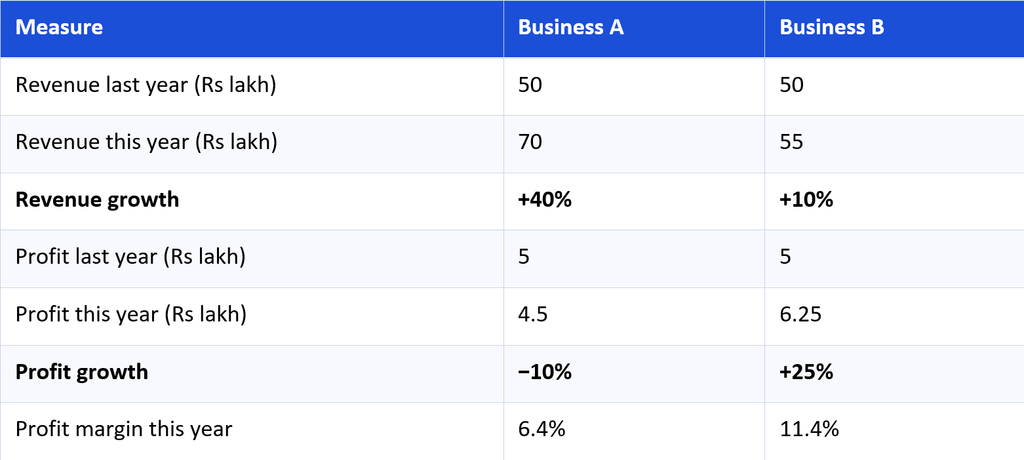
Business A grew its sales by 40%. Business B grew them by only 10%. Yet B earned more profit and keeps almost twice the margin. So which would you rather own?
That gap sits at the heart of revenue growth vs profit growth. One number tells you how fast you’re moving. The other tells you whether the journey is paying off.
Why Revenue Growth vs Profit Growth Matters for Nepali Businesses
In Nepal, margins are often thin. For example, city rents are high, loan interest adds up, and customers expect udharo. At the same time, festival seasons tempt owners to push sales at any cost.
So growth can quietly become expensive. Heavy discounts, for instance, shrink margins. Credit sales tie up cash. Extra stock sits unsold after Tihar. New staff adds fixed costs that continue through the slow months.
Research points the same way. A study of more than 650,000 European small businesses found that firms putting profitability first were more likely to achieve both profit and growth. Firms chasing growth first often ended up with low growth and low profit. You can read a summary of the study from IESEG.
Of course, European data isn’t Nepali data. Still, the lesson travels well. Growth without profit is fragile.
When Revenue Growth Should Come First
Revenue growth deserves priority in some situations. However, profit isn’t always the first goal.
- You’re new. Early on, you need customers, proof, and brand recognition.
- You’re opening a branch or entering a new market. Setup costs come first, and profit follows.
- Your margins are already healthy. If each extra sale adds solid profit, more sales help.
- Scale lowers your costs. Bulk discounts and better supplier terms can lift margins as you grow.
Even then, a revenue-first plan needs a deadline. Decide when each new product, branch, or customer group should break even. Otherwise, “we’ll fix profit later” quietly becomes permanent.
When Profit Growth Should Take Priority
Sometimes the smartest move is to slow down and fix the base. Profit should lead when:
- Sales are rising but cash is tight. That’s a warning sign, not a success.
- Margins are shrinking. More work for less money rarely ends well.
- You rely on loans or heavy udharo. Profit funds growth without borrowing.
- You grew fast and lost control. Pause, tighten your processes, then grow again.
- The market is slowing. Efficient businesses survive downturns more easily.
In these cases, profit growth builds a stronger foundation. Later, growth becomes cheaper, because you fund it from your own earnings instead of from debt.
How to Balance Revenue Growth vs Profit Growth in 5 Steps
The smartest answer to revenue growth vs profit growth isn’t either-or. It’s profitable growth. Here’s a practical way to get there.
Step 1: Know Your Margins by Product and Customer
Not every sale is equal. So find out which products and customers give you healthy margins and which barely cover their costs. You’ll probably find a few stars and a few drains.
Udyot tip: With sales, purchase cost and stock in one system, it's much easier to see what each item earns than with separate sheets.Step 2: Set Paired Targets
Never set a sales target alone. Pair it with a profit or margin target. For example, aim to grow sales by 20% while keeping your net margin above a floor you choose. That way, growth can’t quietly eat your profit.
Step 3: Test Every Discount and Offer
Before any offer, work out how much extra volume you need to make up for the lost margin. If the answer looks unrealistic, skip the offer. Instead, reward loyal customers in ways that don’t cut your price.
Step 4: Protect Your Cash
Growth eats cash first. New stock, new staff, and new udharo all need money before the profit arrives. So track dues by age, set credit limits, and keep a cash buffer for slow months.
Udyot tip: Customer ledgers and outstanding dues sit in one place, so slow payers stand out quickly.Step 5: Review Monthly, Not Yearly
Check revenue, gross margin, net profit, and cash every month. Compare with last month and with the same month in the last fiscal year. Small drifts are easy to fix. Big ones are not.
Udyot tip: Reports update as you work, so a monthly review doesn't have to wait for the CA to close the books.Key Numbers to Track for Profitable Growth
You don’t need dozens of metrics. These seven cover most of what matters.
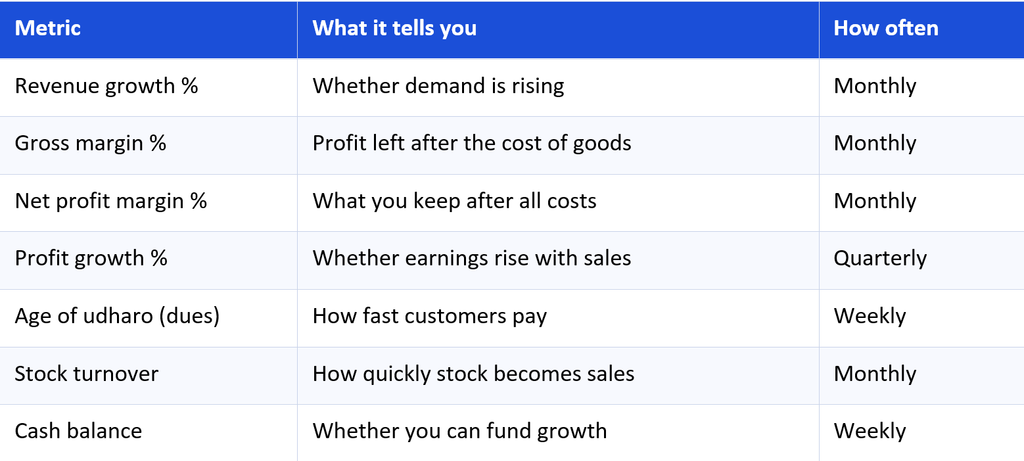
If revenue growth outpaces profit growth for several months in a row, stop and investigate. That gap is usually the first sign of a leak.
Quick Comparison: Revenue Growth vs Profit Growth
Short on time? Then here’s the whole picture at a glance.
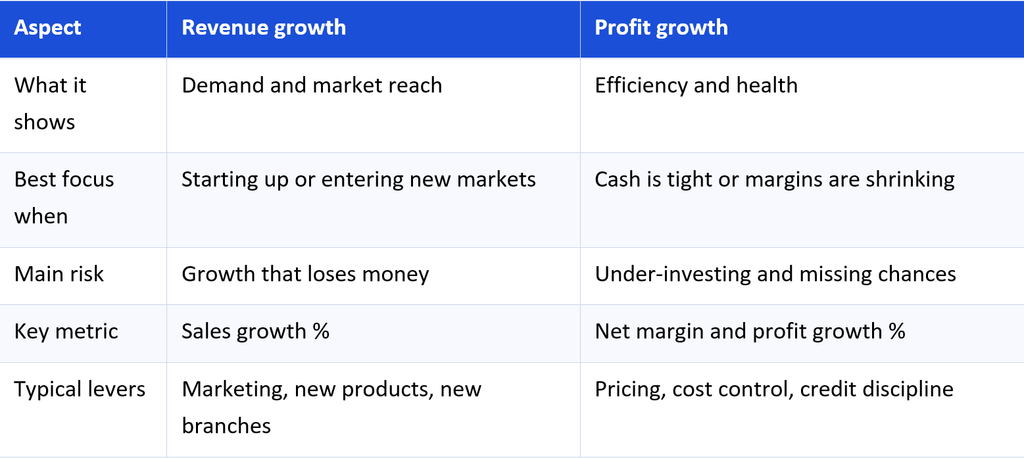
Common Mistakes in Revenue Growth vs Profit Growth Decisions
Even smart owners trip over the same few problems. Watch for these.
- Celebrating sales without checking margin. A bigger top line feels great, but it can hide a shrinking bottom line.
- Copying a competitor’s growth plan. Their costs, funding, and goals differ from yours. So their playbook may not fit.
- Ignoring cash timing. Profit on paper isn’t cash in hand. Credit sales can leave you profitable and broke at the same time.
- Cutting costs too hard. Slashing marketing, training, or stock to boost profit can stall growth. Instead, trim waste, not muscle.
- Reviewing too late. Yearly numbers arrive after the damage is done.
Fixing even two of these makes the revenue growth vs profit growth balance far easier to manage.
How Udyot ERP Helps You Track Revenue Growth vs Profit Growth
Balancing growth and profit gets easier when you can see both numbers together. Most owners can’t, because billing, stock, expenses, and payroll live in separate places.
Here’s a quick glimpse of what a monthly review looks like in Udyot ERP:
- Sales: every invoice, including VAT, is recorded as you bill, so your revenue trend stays current.
- Costs: purchases, expenses, and payroll post to your accounts, so profit and loss reflects real costs.
- Stock: live inventory shows what’s moving and what’s sitting idle.
- Dues: customer ledgers show who owes you and for how long.
- Tax: VAT returns and Annex reports follow IRD formats.
Also, Udyot is cloud-based, includes a mobile app, and uses Bikram Sambat dates. So you can check these numbers from your shop, your office, or your phone. Explore the full feature list or the pricing plans.